Research Article | | Peer-Reviewed

Polymorphism and Genetic Diversity in Senegalese Patients with Oral Cancers

Received: 23 April 2025     Accepted: 7 May 2025     Published: 12 June 2025
Views:       Downloads:
Abstract

Cancer is the leading cause of death and a major obstacle to increasing life expectancy worldwide in the 21st century. Oral cavity cancers are the most common type of head and neck cancers. This study aimed to determine the polymorphism and genetic diversity of the tumor protein P53 (TP53) in oral cavity cancers in Senegal. From a total of 40 patients with oral cavity cancer, we collected 40 cancerous tissue samples, 20 adjacent healthy tissue samples, and 15 blood samples. Blood samples were collected from participants in the control group. Tissue samples were obtained from each patient during a biopsy after obtaining informed consent. DNA extraction, polymerase chain reaction (PCR), and sequencing were performed. MEGA, BioEdit, and DnaSP software were used to analyze polymorphisms and genetic diversity. A total of 36.80%, 22.27%, and 7.74% polymorphic sites were found in cancerous tissues, healthy tissues, and blood samples, respectively. Nine amino acids showed significant differences in distribution between participants in the control group and patients. Significant differences were also observed within and between populations. This study revealed an increasing number of oral cancer cases in Senegal. Moreover, healthy tissues exhibited the same genetic alterations as cancerous tissues.

Published in Cancer Research Journal (Volume 13, Issue 2)
DOI 10.11648/j.crj.20251302.13
Page(s) 46-55
Creative Commons

This is an Open Access article, distributed under the terms of the Creative Commons Attribution 4.0 International License (http://creativecommons.org/licenses/by/4.0/), which permits unrestricted use, distribution and reproduction in any medium or format, provided the original work is properly cited.

Copyright

Copyright © The Author(s), 2025. Published by Science Publishing Group

Keywords

Cancer, Oral, Cavity, TP53, Polymorphism, Diversity, Senegal

1. Introduction
Cancer is the leading cause of death and a major obstacle to increasing life expectancy worldwide in the 21st century. The disease can affect almost any organ in the body. Notably, cancers of the oral cavity are the most common among head and neck cancers (HNCs) . Oral cancer is estimated to account for 890,000 newly diagnosed cases and 450,000 deaths worldwide . In Senegal, these cancers have become increasingly frequent, representing 1.76% of all malignant tumors. In 2020, the mortality rate reached 64.40% in Senegal .
Despite advancements in diagnostic and therapeutic approaches, the prognosis for patients with these cancers has not significantly improved in recent years. This is primarily due to the marked clinical heterogeneity in the biological behavior of these tumors, as well as late diagnosis, lymph node metastases, and recurrences, leading to high mortality rates for HNCs .
A major research challenge lies in understanding the genetic and anatomical diversity of tumors, including those of the oral cavity. Nevertheless, considerable advances have been made in cancer genomics, leading to an increasingly detailed understanding of the genetic landscape of the most common tumor types. Moreover, molecular and immunohistochemical markers play a crucial role in the management of oral cancers .
In particular, tumor suppressor genes can undergo various genetic alterations. Due to its high mutation frequency and critical role in cancer development and progression, the tumor protein P53 (TP53) gene is a key target for cancer therapy. Therefore, molecular analysis of specific components of the p53 pathway is likely to have both diagnostic and prognostic value for these cancers. Screening for TP53 polymorphisms is rapidly becoming an integral part of many therapeutic and preventive strategies in clinical practice . This could facilitate treatment response predictions and enable individualized therapies for patients with oral cancer based on the genetic profile of their tumors .
Therefore, this study aimed to determine the polymorphism and genetic diversity of TP53 in Senegalese patients with oral cavity cancer.
2. Methodology
2.1. Samples
This study was conducted on Senegalese patients with histologically confirmed oral cancer who were treated at the Maxillofacial and Stomatology Department of Aristide Le Dantec Hospital in Dakar. After obtaining approval from the Research Ethics Committee of Cheikh Anta Diop University in Dakar, Senegal (Reference: Protocol 0272/2018/CER/UCAD), the study was carried out from February 2021 to March 2023.
The inclusion criteria were as follows: (a) Senegalese patient, (b) diagnosed with oral cavity cancer, and (c) regularly followed up at a hospital center with a signed consent form. A total of 40 cancer patients and 52 healthy individuals were included in this study as controls and were assigned identification numbers accordingly.
Cancerous tissue, healthy tissue, and peripheral blood samples were collected from each patient during a biopsy. Blood samples were also collected from participants in the control group.
2.2. DNA Extraction, Polymerase Chain Reaction, and Sequencing
DNA was extracted from tissues and blood using the Zymo Research Kit, following the manufacturer’s instructions for each biological material. The region spanning exons 5 to 6 of the gene was amplified using the following primers: F 5′-GTTTCTTTGCTGCCGTCTTC-3′ and R 5′-CTTAACCCCTCCTCCCAGAG-3′.
PCR was performed in a 25 µL reaction volume containing 12.5 µL of master mix, 0.5 µL of each primer, 9.5 µL of Milli-Q water, and 2 µL of cDNA. The thermal cycling conditions were as follows: an initial denaturation at 94 °C for 7 minutes, followed by 35 cycles of denaturation at 94 °C for 1 minute, annealing at 64 °C for 1 minute, and extension at 72 °C for 1 minute. A final extension step was performed at 72 °C for 10 minutes.
PCR products were visualized under blue light, purified, and subsequently sequenced using the ABI Big Dye Terminator Sequencing Ready Reaction Kit on an ABI PRISM 3730xl sequencer (Applied Biosystems, Foster City, CA, USA).
2.3. Genetic Diversity Analysis
Sequences obtained from tissues (cancerous and healthy) and blood were carefully checked, aligned, and corrected using BioEdit version 7.1.9 . Sequence alignment was performed to identify similarities and determine positions of potential deletions or insertions.
Pairwise comparisons were conducted between cancerous and healthy tissues, as well as between cancerous tissues and blood samples, for each individual. The degree of similarity, average number of nucleotide differences (K), haplotype diversity index (Hd, the probability that two randomly drawn haplotypes are different), and nucleotide diversity index (π, the probability that two randomly drawn sequences differ at a given site) were assessed. These parameters were calculated using BioEdit version 7.1.9 and DnaSP version 5.10 .
Genetic distance, defined as the average number of substitutions per site since the divergence of two sequences, was determined using MEGA version 11 .
A population-level analysis was also conducted. The following parameters were calculated using DnaSP version 5.10: sample size (n), total number of sites (N), number of variable sites, number of non-informative variable sites, number of informative variable sites, total number of mutations (Eta), average number of nucleotide differences between sequences (K), number of haplotypes, nucleotide diversity index (π), and haplotype diversity index (Hd).
The total number of sites (N) represents the sequence length without gaps. Variable sites are positions where at least two different nucleotides are observed at varying frequencies. Non-informative variable sites contain at least two nucleotide types, with one being significantly more frequent. Informative variable sites have at least two nucleotide types, each present in at least two compared sequences.
Additionally, the percentage of transitions and transversions, as well as the mutation rate (R, the ratio of transitions to transversions), were evaluated using MEGA version 11.
2.4. Analysis of the Variability of the Amino Acids Encoded by TP53
The frequency distribution of the 20 amino acids was evaluated across controls, cancerous tissues, healthy tissues, and diseased blood. To determine whether there were significant differences in the frequency distribution of each amino acid between population pairs, the amino acid frequency data were analyzed using R software version 4.2.2 (R Core Team, 2022).
The Shapiro-Wilk normality test was performed to assess whether the data followed a normal distribution. If the data were normally distributed, an analysis of variance (ANOVA) test was used to compare the means. For non-normally distributed data, the Kruskal-Wallis test was applied.
Amino acids that showed significant differences in distribution among the four groups (controls, cancerous tissue, healthy tissue, and diseased blood) were further analyzed to determine pairwise differences. For normally distributed data, a pairwise test was conducted, whereas for non-normally distributed data, the Dunn test was used. A significance level of 0.05 was applied for all statistical analyses.
2.5. Analysis of Demographic Evolution
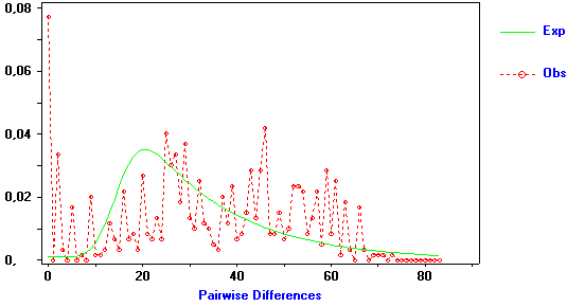
Mismatch distribution curves for genetic distances between paired cancer tissue samples were generated using DnaSP software version 5.10.01. The P-values of demographic indices, including the sum of squared deviations (SSD) and Harpending’s raggedness index (HRI), were calculated to compare the observed distributions. This analysis was conducted to assess the validity of the expansion model . using Arlequin software version 3.5.1.3 .
If the P-values of SSD and HRI are significant, the population is considered to be in demographic equilibrium or stable. Conversely, if the P-values of SSD and HRI are not significant, the population is undergoing expansion.
3. Results
3.1. Individual Analysis
After alignment and correction, 413 sites were obtained from 82 sequences, including 23 controls, 35 cancerous tissue samples, 15 healthy tissue samples, and 9 blood samples. A total of 30 sequences were excluded due to high diversity and ambiguity.
Individual analyses were conducted on 16 individuals with at least two different tissue types (Table 1). The similarity between cancerous and healthy tissues ranged from 83.2% to 99.5%, with an average of 30.57 nucleotide differences. Haplotype diversity was 1, and nucleotide diversity ranged from 0.03 to 0.16. Genetic distances between cancerous and healthy tissues within individuals ranged from 0.07 to 0.191.
The similarity between cancerous tissues and blood samples ranged from 79.6% to 100%, with an average of 30.14 nucleotide differences. Haplotype diversity was 1, except for individual 15, in whom the cancerous tissue and blood were identical. Nucleotide diversity ranged from 0 to 0.20, and genetic distances varied from 0 to 0.215.
Table 1. Parameters of genetic diversity at the individual level.

Individuals

Tissues

Degree of similarity (%)

Average number of nucleotide differences (K)

Hd ± variance

π ± variance

Genetic distance (d)

7

TC /TS

87.1

53

1 ± 0.25

0.12 ± 0.004

0.134 ± 0.19

8

TC/TS

93.9

24

1 ± 0.25

0.06 ± 0.0009

0.081 ± 0.015

TC/Sg

98.7

5

1 ± 0.25

0.01 ± 0.0000

0.017 ± 0.007

11

TC/TS

84

65

1 ± 0.25

0.15 ± 0.006

0.191 ± 0.022

12

TC/TS

94.6

22

1 ± 0.25

0.05 ± 0.0007

0.077 ± 0.015

TC/Sg

95.8

16

1 ± 0.25

0.03 ± 0.0003

0.054 ± 0.013

15

TC/TS

96.1

15

1 ± 0.25

0.03 ± 0.0003

0.050 ± 0.012

TC/Sg

100

00

00 ± 000

00 ± 000

00 ± 000

17

TC/TS

86.6

55

1 ± 0.25

0.13 ± 0.009

0.094 ± 0.016

19

TC/TS

96.3

14

1 ± 0.25

0.03 ± 0.0002

0.047 ± 0.012

20

TC/TS

83.2

68

1 ± 0.25

0.16 ± 0.006

0.136 ± 0.016

TC/Sg

82.5

71

1 ± 0.25

0.17 ± 0.007

0.198 ± 0.022

21

TC/TS

83.2

69

1 ± 0.25

0.16 ± 0.006

0.187 ± 0.022

23

TC/Sg

94.4

23

1 ± 0.25

0.05 ± 0.0007

0.077 ± 0.015

28

TC/Sg

96.8

13

1 ± 0.25

0.03 ± 0.0002

0.044 ± 0.012

29

TC/TS

86.4

56

1 ± 0.25

0.13 ± 0.009

0.124 ± 0.019

TC/Sg

79.6

83

1 ± 0.25

0.20 ± 0.01

0.215 ± 0.023

32

TC/TS

86.1

57

1 ± 0.25

0.13 ± 0.009

0.110 ± 0.017

33

TC/TS

94.6

23

1 ± 0.25

0.05 ± 0.0007

0.070 ± 0.014

35

TC/TS

99.5

2

1 ± 0.25

0.04 ± 0.0000

0.07 ± 0.005

37

TC/TS

94.9

23

1 ± 0.25

0.05 ± 0.0007

0.067 ± 0.014

Note. TC, cancerous tissue; TS, healthy tissue; Sg, blood; Hd, haplotypic diversity indices; π, nucleotide diversity indices
3.2. Population Analyses
In cancerous tissues, 152 polymorphic sites (36.80%) were detected. Of these, 24.34% were non-informative, while 75.65% were parsimony-informative sites. In healthy tissues, 22.27% of the sites were polymorphic, with 55.43% being non-informative and 44.56% being parsimony-informative. In blood samples, 7.74% of the sites were polymorphic, of which 81.25% were non-informative and 18.75% were parsimony-informative.
The total number of mutations (Eta) and the average number of nucleotide differences (k) were 228 and 41.10 in cancerous tissues, 109 and 26.98 in healthy tissues, and 38 and 9.25 in blood, respectively. Cancerous tissues comprised 25 haplotypes, healthy tissues 14 haplotypes, and blood samples 5 haplotypes.
Additionally, 64.36% of the mutations observed in cancerous tissues were transitions, compared to 42.25% in healthy tissues and 88.26% in blood samples. High haplotype diversity and low nucleotide diversity were observed in cancerous tissues (Hd = 0.923, π = 0.099), healthy tissues (Hd = 0.990, π = 0.065), and blood samples (Hd = 0.772, π = 0.022). The results are presented in Table 2.
The control samples exhibited 11 polymorphic sites out of 413, with only 2 being informative, highlighting their genetic differences from cancer patients.
Table 2. Parameters of genetic diversity at the population level.

Genetic diversity parameter

T

TC

TS

Sg

Sample size

23

35

15

9

Number of variable sites

11 (2.66%)

152 (36.80%)

92 (22.27%)

32 (7.74%)

Non informative sites

9 (81.81%)

37 (24.34%)

51 (55.43%)

26 (81.25%)

Informative sites

2 (18.18%)

115 (75.65%)

41 (44.56%)

6 (18.75%)

Total number of mutation (Eta)

13 (3.15%)

228 (55.20%)

109 (26.39%)

38 (9.20%)

Number of haplotypes (h)

9

25

14

5

Average number of nucleotide differences (K)

1.66

41.10

26.98

9.25

% transition

81.41

64.36

42.85

88.26

% transversal

18.59

35.64

57.14

11.74

R

4.17

1.74

0.73

7.45

Haplotype diversity index (Hd)

0.58 ± 0.01

0.923 ± 0.00

0.990 ±0.00

0.722 ± 0.02

Nucleotide diversity index (π)

0.004 ± 0.00

0.099 ± 0.00

0.065 ± 0.00

0.022 ± 0.00

Note. T, control; TC, cancerous tissue; TS, healthy tissue; Sg, blood
3.3. Frequency and Distribution Difference of Amino Acids
The distribution of the mean frequency of amino acids in TP53 exons 5 and 6 among controls, cancerous tissues, healthy tissues, and blood samples showed a significant difference for nine amino acids (Table 3). Levels of Ala, Gly, Ile, and Gln were significantly increased in cancerous and healthy tissues of cancer patients compared to participants in the control group. In contrast, levels of His, Pro, Ser, Val, and Tyr were significantly decreased in cancerous and healthy tissues.
The significance of the distribution of these amino acids across population pairs is shown in Table 4. A highly significant difference was observed in the distribution of these amino acids between controls and cancerous tissues, as well as between controls and healthy tissues of cancer patients. However, the difference in distribution between controls and blood samples from cancer patients was not statistically significant.
Table 3. Frequency of amino acids.

Amino acids

T

TC

TS

Sg

P-value

Ala

5.05

5.29

5.59

5.16

0.001641*

Cys

4.04

4.10

4.11

4.04

0.478

Asp

5.09

4.71

4.78

5.28

0.1645

Glu

6.01

6.24

7.01

5.84

0.1036

Phe

2.02

2.22

2.09

2.02

0.07406

Gly

3.03

4.85

4.72

3.48

1.078e-05*

His

4.96

4.33

4.45

4.94

0.01196*

Ile

2.02

2.54

2.62

2.02

6.932e-05*

Lys

3.07

3.26

3.30

3.14

0.1959

Leu

7.07

7.40

7.34

7.19

0.2216

Met

3.03

3.15

3.10

3.14

0.2082

Asn

3.33

2.86

3.03

2.92

0.4848

Pro

11.11

10.40

9.77

10.44

0.01355*

Gln

5.35

6.10

6.20

5.84

0.003478*

Arg

8.82

8.67

8.56

8.76

0.4278

Ser

5.84

5.75

5.12

5.95

0.01*

Thr

5.05

4.97

4.85

5.05

0.7117

Val

10.05

8.67

8.90

9.77

9.343e-05*

Trp

1.01

1.15

1.07

1.01

0.08561

Tyr

3.99

3.26

3.30

3.93

0.000105*

Note. T, control; TC, cancerous tissue; TS, healthy tissue; Sg, blood; *, significant P-value
Table 4. Difference in distribution between populations.

Ala

T

TC

TS

TC

0.0107*

TS

0.0001*

0.0162*

Sg

0.1446

0.2953

0.0206*

Gly

TC

0.0000*

TS

0.0001*

0.4808

Sg

0.1063

0.0214*

0.0336

His

TC

0.0021*

TS

0.0087*

0.1801

Sg

0.4018

0.0364

0.0504

Ile

TC

0.0001*

TS

0.0001*

0.2309

Sg

0.3370

0.0111*

0.0052*

Pro

TC

0.0432*

TS

0.0007*

0.0254*

Sg

0.0462

0.2948

0.1707

Gln

TC

0.0006*

TS

0.0020*

0.3971

Sg

0.2324

0.0585

0.0570

Ser

TC

0.3936

TS

0.0028*

0.0030*

Sg

0.2314

0.1669

0.0021*

Val

TC

0.0000*

TS

0.0009*

0.3837

Sg

0.2477

0.0104*

0.0333

Tyr

TC

0.0001*

TS

0.0004*

0.3465

Sg

0.3837

0.0037*

0.0039*

Note. T, control; TC, cancerous tissue; TS, healthy tissue; Sg, blood; *, significant P-value
3.4. Mismatch Distribution Curve
The curve exhibits a multimodal pattern, with non-significant P-values for Harpending’s raggedness index (HRI) and the sum of squared deviations (SSD). This suggests a gradual increase in the number of oral cancer cases in Senegal.
Figure 1. Mismatch distribution curve. P-value HRI = 0.06, P-value SSD = 0.33. Exp, Expected population; Obs, Observed population.
4. Discussion
This study aimed to determine the polymorphisms and genetic diversity of TP53 in patients with oral cavity cancer in Senegal. Our results show that within the same patient, the similarity between tissues, although strong, is not absolute. Therefore, the cancerous tissue, healthy tissue, and blood of each patient are not genetically identical, which may indicate the presence of mutational differences. When a biopsy is taken, the healthy tissue is usually obtained from an area adjacent to the cancer-affected region. Given that the oral cavity is a small anatomical site and that some patients are diagnosed at a late stage, the supposedly healthy tissue may already be undergoing malignant transformation.
These findings align with those of Samb et al. , who observed similar instability of the BAT-26 locus between cancerous and healthy tissues in individuals with oral cavity cancer. This hypothesis is further supported by the significantly lower polymorphism observed in the blood of affected individuals compared to cancerous and healthy tissues. This suggests that in oral cancer patients, mutations are more prevalent in tumor and adjacent tissues than in the blood, indicating that TP53 gene mutations are primarily localized within oral cavity tissues. These data demonstrate that oral cancers exhibit varying levels of intra- and inter-tumor mutational burden, contributing to overall genetic diversity.
Similarly, Califano et al. hypothesized that specific genetic events typically occur in a particular sequence, though this progression may vary between tumors. Considerable genetic variation has been reported between different cell lines of the same cancer and even within individual cell lines, as noted by Pajonk et al. . This suggests that the accumulation of genetic alterations plays a crucial role in tumor progression. From a therapeutic perspective, our findings highlight the challenges of relying on single-site biopsies for precision medicine.
In addition to individual-level analyses, population-level comparisons also revealed tissue-specific differences. The percentage of parsimony-informative sites was 75.65% in cancerous tissue, 55.43% in healthy tissue, and 18.75% in blood. These findings highlight differences in polymorphism, with blood samples from cancer patients showing lower variability than diseased tissues. Furthermore, genetic similarities were observed between cancerous and healthy tissues, consistent with the results of Diatta et al. , who found genetic similarities between these tissue types in exon 4 of the TP53 gene in Senegalese oral cancer patients.
Genetic markers associated with TP53 mutations indicate that at least 35% of oral and oropharyngeal tumors are surrounded by mucosal epithelium with genetic alterations . The epithelium adjacent to the tumor, referred to as the "field," appears macroscopically normal but exhibits genetic modifications . Clinically, this "field" may contribute to local recurrence and the development of additional primary tumors following surgical resection . These results strongly suggest that early TP53 mutations drive genomic instability, clonal expansion, and the multi-step progression of cancer . Molecular approaches could help identify cells harboring TP53 mutations in clinically normal oral mucosa distant from the tumor. This could assist in distinguishing patients at risk of developing secondary tumors due to large, potentially precancerous fields surrounding their initial cancer .
Although diseased blood samples in this study exhibited low polymorphism, analyzing a larger population with equal numbers of cancerous, healthy, and blood-derived tissue samples could provide more insight. Gasco and Crook have suggested that TP53 mutations can be detected in the peripheral blood of a significant proportion of patients whose primary tumors contain these mutations. Therefore, detecting genetic alterations in blood may serve as a relatively simple method for cancer diagnosis.
Our study found a higher percentage of transitions than transversions. The most prevalent mutations in exons 5 and 6 among Senegalese patients were transitions, which aligns with the findings of Saleem et al. , who reported that transitions were 3.5 times more frequent in patients with lip cancer. These results are further supported by Erber et al. , who observed 19 transitions versus 16 transversions in their study. Thus, mutation hotspots in oral cancer may be shaped primarily by transition mutations in this region of the gene.
High haplotype diversity and low nucleotide diversity were observed in this study, suggesting that TP53 mutations accumulate rapidly in the Senegalese oral cancer population. According to Nowell’s clonal evolution model , genetic changes occurring in individual cancer cells over time contribute to tumor heterogeneity without a hierarchical tumor structure . The development of many cancers is thought to require the accumulation of successive mutations over an extended period .
Our results also revealed a statistically significant difference in the distribution of nine amino acids. The levels of Ala, Gly, Ile, and Gln were significantly higher in cancerous and healthy tissues of cancer patients compared to controls. In contrast, the levels of His, Pro, Ser, Val, and Tyr were significantly lower in cancerous and healthy tissues.
However, these findings are not universally consistent with other studies. For instance, Musharraf et al. reported a progressive decrease in the concentrations of Ala, Gly, and Gln, alongside an increase in Val, across healthy control tissues, preneoplastic lesions, and oral cancer. Nevertheless, they also observed decreases in Pro and Ser levels, which align with our findings.
Similarly, Mbaye et al. reported a significant increase in Gln levels in breast cancer tissues. These findings suggest that cancer cells may activate alternative metabolic pathways to support rapid growth, requiring increased levels of glucogenic amino acids . Additionally, amino acids are continuously utilized for cell proliferation, leading to fluctuating concentrations depending on their availability and consumption in tumor cell production .
Alterations in the levels of Ile and Val, two branched-chain essential amino acids, were also observed in cancerous tissues. While Val and Ile are fundamental building blocks for tissue proteins, they are also directly incorporated into proteins . Disruptions in their metabolism may affect the intrinsic properties of cancer cells and reflect systemic changes associated with certain cancers . The decreased histidine levels observed in cancerous tissues may reflect increased metabolic demand, oxidative stress response, or altered immune signaling within the tumor microenvironment, all of which are common features of cancer metabolism. Recent research suggests that targeting amino acid metabolic enzymes could serve as a promising strategy for developing new cancer therapies. Val, Ile and His may serve as potential biomarkers for oral cancer pathology in Senegal.
This study observed an increasing number of oral cancer cases in Senegal, which may be linked to the rapid accumulation of mutations in this population. One of the prevailing models of tumor evolution suggests that mutations accumulate in a stepwise manner, leading to progressively more malignant stages . Consequently, natural selection in tumors is evidenced by subclonal mutations and convergent evolution. Selective sweeps, which indicate significant genetic shifts, can be identified by analyzing changes in effective population size based on variable frequency distributions .
5. Conclusion
Although this study is limited by a small sample size, it could provide valuable insights for surgeons, helping them determine whether to extend or deepen the excision area to reduce the risk of recurrence. However, further studies with larger sample sizes and more advanced laboratory techniques are necessary to validate our findings.
Multiple TP53 gene alterations were detected in this study, suggesting that TP53 may serve as a useful molecular marker in oral cancers. These alterations were identified in various patient tissues, highlighting the need to assess their clinical significance. Future studies should evaluate the potential of detecting TP53 alterations in tumor margins or bodily fluids, such as saliva or blood, as a means of identifying residual disease. Understanding how different mutations influence tumor development and unraveling the heterogeneity of molecular targets across different tissues will be crucial not only for improving cancer treatment but also for elucidating the role of TP53 in normal cellular processes. This knowledge could aid in predicting cancer progression and informing treatment decisions.
Finally, the evaluation of TP53 gene transfer as an adjuvant therapy for advanced head and neck cancer has shown some promising results. Further research is needed to confirm its efficacy and explore its potential within multimodal therapeutic strategies.
Abbreviations

T

Control

TC

Cancerous Tissue

TS

Healthy Tissue

Sg

Blood

Ethical Approval
Approval was granted by the Ethics Committee of the Cheikh Anta DIOP University of Dakar (date 2018/N°0272).
Consent to Participate
Informed consent was obtained from all individual participants included in the study.
Author Contributions
Mame Diarra Samb: Conceptualization, Data curation, Formal Analysis, Methodology, Software, Writing - original draft
Fatimata Mbaye: Conceptualization, Supervision, Validation, Visualization, Writing - review & editing
Silly Toure: Supervision, Validation, Visualization
Mbacke Sembene: Conceptualization, Resources, Supervision, Validation, Visualization
Funding
This research received no specific funding from public, commercial or not-for-profit funding bodies.
Conflicts of Interest
The authors declare no conflicts of interest.
References
[1] Principe, S., Hui, A. B. Y., Bruce, J., Sinha, A., Liu, F. F., & Kislinger, T. (2013). Tumor-derived exosomes and microvesicles in head and neck cancer: implications for tumor biology and biomarker discovery. Proteomics, 13(10-11), 1608-1623.
[2] Chow, L. Q. (2020). Head and neck cancer. New England Journal of Medicine, 382(1), 60-72.
[3] Global Cancer Observatory (GLOBOCAN)/2020 Data. Cancer Today. International Agency for Research on Cancer/OMS.
[4] Duprez, F., Berwouts, D., De Neve, W., Bonte, K., Boterberg, T., Deron, P., Huvenne, H., Rottey, S., & Mareel, M. (2017). Distant metastases in head and neck cancer. Head & neck, 39(9), 1733-1743.
[5] Gasco, M., & Crook, T. (2003). The p53 network in head and neck cancer. Oral oncology, 39(3), 222-231.
[6] Friedlander, P. L. (2001). Genomic instability in head and neck cancer patients. Head & neck, 23(8), 683-691.
[7] Hall, T. A. (1999, January). BioEdit: a user-friendly biological sequence alignment editor and analysis program for Windows 95/98/NT. In Nucleic Acids Symposium Series (Vol. 41, No. 41, pp. 95-98). [London]: Information Retrieval Ltd., c1979-c2000.
[8] Rozas J., Librado P., Sánchez-Del Barrio J. C., Messeguer X. and Rozas R. 2012. DnaSP Version 5 Help Contents [Help File]. Available with the program at
[9] Tamura, K., Stecher, G., & Kumar, S. (2021). MEGA11: molecular evolutionary genetics analysis version 11. Molecular biology and evolution, 38(7), 3022-3027.
[10] Rogers, A. R., and Harpending, H. (1992). Population growth makes waves in the distribution of pairwise genetic differences. Molecular Biology and Evolution, 9(3), 552-569.
[11] Schneider, S., & Excoffier, L. (1999). Estimation of past demographic parameters from the distribution of pairwise differences when the mutation rates vary among sites: application to human mitochondrial DNA. Genetics, 152(3), 1079-1089.
[12] Excoffier, L., and Lischer, H. E. (2010). Arlequin suite ver 3.5: a new series of programs to perform population genetics analyses under Linux and Windows. Molecular Ecology Resources, 10(3), 564-567.
[13] Samb, M. D., Mbaye, F., Ndiaye, M. M., Toure, S., & Sembene, M. (2023). Bat 26 Microsatellite Instability in Oral Cavity Cancers in Senegal. Journal of Cancer Therapy, 14(1), 25-37.
[14] Califano, J., van der Riet, P., Westra, W., Nawroz, H., Clayman, G., Piantadosi, S., Corio, R., Lee, D., Greenberg, B., Koch, W., & Sidransky, D. (1996). Genetic progression model for head and neck cancer: implications for field cancerization. Cancer Research, 56(11), 2488-2492.
[15] Pajonk, F., Vlashi, E., & McBride, W. H. (2010). Radiation resistance of cancer stem cells: the 4 R's of radiobiology revisited. Stem Cells, 28(4), 639-648.
[16] Diatta, H., Mbaye, F., Gueye M. D., Ndiaye M. M., Samb M. D., Fall, M., Diallo, B. K., Toure, S., and Sembene, M. (2021). Genetic mutations of exon 4 at TP53 gene in oral cavity cancers. Oral Health and Care, 6, 2399-9640.
[17] Tabor, M. P., Brakenhoff, R. H., van Houten, V. M., Kummer, J. A., Snel, M. H., Snijders, P. J., Snow, G. B., Leemans, C. R., & Braakhuis, B. J. (2001). Persistence of genetically altered fields in head and neck cancer patients: biological and clinical implications. Clinical Cancer Research: An Official Journal of the American Association for Cancer Research, 7(6), 1523-1532.
[18] Tabor, M. P., Braakhuis, B. J., van der Wal, J. E., van Diest, P. J., Leemans, C. R., Brakenhoff, R. H., & Kummer, J. A. (2003). Comparative molecular and histological grading of epithelial dysplasia of the oral cavity and the oropharynx. The Journal of Pathology: A Journal of the Pathological Society of Great Britain and Ireland, 199(3), 354-360.
[19] Leemans, C. R., Braakhuis, B. J., & Brakenhoff, R. H. (2011). The molecular biology of head and neck cancer. Nature Reviews Cancer, 11(1), 9-22.
[20] Zhou, G., Liu, Z., & Myers, J. N. (2016). TP53 mutations in head and neck squamous cell carcinoma and their impact on disease progression and treatment response. Journal of Cellular Biochemistry, 117(12), 2682-2692.
[21] Partridge, M., Pateromichelakis, S., Phillips, E., Emilion, G. G., A’Hern, R. P., & Langdon, J. D. (2000). A case-control study confirms that microsatellite assay can identify patients at risk of developing oral squamous cell carcinoma within a field of cancerization. Cancer Research, 60(14), 3893-3898.
[22] Pateromichelakis, S., Farahani, M., Phillips, E., & Partridge, M. (2005). Molecular analysis of paired tumours: time to start treating the field. Oral Oncology, 41(9), 916-926.
[23] Saleem, S., Abbasi, Z. A., Hameed, A., Qureshi, N. R., Khan, M. A., & Azhar, A. (2014). Novel p53 codon 240 Ser> Thr coding region mutation in the patients of oral squamous cell carcinoma (OSCC). Tumor Biology, 35, 7945-7950.
[24] Erber, R., Conradt, C., Homann, N., Enders, C., Finckh, M., Dietz, A., & Bosch, F. X. (1998). TP53 DNA contact mutations are selectively associated with allelic loss and have a strong clinical impact in head and neck cancer. Oncogene, 16(13), 1671-1679.
[25] Nowell, P. C. (1976). The clonal evolution of tumor cell populations: acquired genetic lability permits stepwise selection of variant sublines and underlies tumor progression. Science, 194(4260), 23-28.
[26] Shackleton, M., Quintana, E., Fearon, E. R., & Morrison, S. J. (2009). Heterogeneity in cancer: cancer stem cells versus clonal evolution. Cell, 138(5), 822-829.
[27] Reid, P. A., Wilson, P., Li, Y., Marcu, L. G., & Bezak, E. (2017). Current understanding of cancer stem cells: review of their radiobiology and role in head and neck cancers. Head & Neck, 39(9), 1920-1932.
[28] Musharraf, S. G., Shahid, N., Naqvi, S. M. A., Saleem, M., Siddiqui, A. J., & Ali, A. (2016). Metabolite profiling of preneoplastic and neoplastic lesions of oral cavity tissue samples revealed a biomarker pattern. Scientific Reports, 6(1), 38985.
[29] Mbaye F., 2015. Breast cancer in Senegalese women: impact of nucleotide mutations and microsatellite loci instability. Doctoral thesis, Population Genetics, Dakar: Cheikh Anta Diop University, 129 pages.
[30] Yang, X., Coulombe-Huntington, J., Kang, S., Sheynkman, G. M., Hao, T., Richardson, A., Sun, S., Yang, F., Shen, Y. A., Murray, R. R., Spirohn, K., Begg, B. E., Duran-Frigola, M., MacWilliams, A., Pevzner, S. J., Zhong, Q., Wanamaker, S. A., Tam, S., Ghamsari, L., Sahni, N., & Vidal, M. (2016). Widespread expansion of protein interaction capabilities by Alternative splicing. Cell, 164(4), 805-817.
[31] Peng, H., Wang, Y., & Luo, W. (2020). Multifaceted role of branched-chain amino acid metabolism in cancer. Oncogene, 39(44), 6747-6756.
[32] Sivanand, S., & Vander Heiden, M. G. (2020). Emerging roles for branched-chain amino acid metabolism in cancer. Cancer cell, 37(2), 147-156.
[33] Davis, A., Gao, R., & Navin, N. (2017). Tumor evolution: linear, branching, neutral or punctuated? Biochimica and Biophysica Acta (BBA)-Reviews on Cancer, 1867(2), 151-161.
[34] Polanski, A., & Kimmel, M. (2003). New explicit expressions for relative frequencies of single-nucleotide polymorphisms with application to statistical inference on population growth. Genetics, 165(1), 427-436.
Cite This Article
  • APA Style

    Samb, M. D., Mbaye, F., Toure, S., Sembene, M. (2025). Polymorphism and Genetic Diversity in Senegalese Patients with Oral Cancers. Cancer Research Journal, 13(2), 46-55. https://doi.org/10.11648/j.crj.20251302.13

    Copy | Download

    ACS Style

    Samb, M. D.; Mbaye, F.; Toure, S.; Sembene, M. Polymorphism and Genetic Diversity in Senegalese Patients with Oral Cancers. Cancer Res. J. 2025, 13(2), 46-55. doi: 10.11648/j.crj.20251302.13

    Copy | Download

    AMA Style

    Samb MD, Mbaye F, Toure S, Sembene M. Polymorphism and Genetic Diversity in Senegalese Patients with Oral Cancers. Cancer Res J. 2025;13(2):46-55. doi: 10.11648/j.crj.20251302.13

    Copy | Download

  • @article{10.11648/j.crj.20251302.13,
      author = {Mame Diarra Samb and Fatimata Mbaye and Silly Toure and Mbacke Sembene},
      title = {Polymorphism and Genetic Diversity in Senegalese Patients with Oral Cancers
    },
      journal = {Cancer Research Journal},
      volume = {13},
      number = {2},
      pages = {46-55},
      doi = {10.11648/j.crj.20251302.13},
      url = {https://doi.org/10.11648/j.crj.20251302.13},
      eprint = {https://article.sciencepublishinggroup.com/pdf/10.11648.j.crj.20251302.13},
      abstract = {Cancer is the leading cause of death and a major obstacle to increasing life expectancy worldwide in the 21st century. Oral cavity cancers are the most common type of head and neck cancers. This study aimed to determine the polymorphism and genetic diversity of the tumor protein P53 (TP53) in oral cavity cancers in Senegal. From a total of 40 patients with oral cavity cancer, we collected 40 cancerous tissue samples, 20 adjacent healthy tissue samples, and 15 blood samples. Blood samples were collected from participants in the control group. Tissue samples were obtained from each patient during a biopsy after obtaining informed consent. DNA extraction, polymerase chain reaction (PCR), and sequencing were performed. MEGA, BioEdit, and DnaSP software were used to analyze polymorphisms and genetic diversity. A total of 36.80%, 22.27%, and 7.74% polymorphic sites were found in cancerous tissues, healthy tissues, and blood samples, respectively. Nine amino acids showed significant differences in distribution between participants in the control group and patients. Significant differences were also observed within and between populations. This study revealed an increasing number of oral cancer cases in Senegal. Moreover, healthy tissues exhibited the same genetic alterations as cancerous tissues.
    },
     year = {2025}
    }
    

    Copy | Download

  • TY  - JOUR
    T1  - Polymorphism and Genetic Diversity in Senegalese Patients with Oral Cancers
    
    AU  - Mame Diarra Samb
    AU  - Fatimata Mbaye
    AU  - Silly Toure
    AU  - Mbacke Sembene
    Y1  - 2025/06/12
    PY  - 2025
    N1  - https://doi.org/10.11648/j.crj.20251302.13
    DO  - 10.11648/j.crj.20251302.13
    T2  - Cancer Research Journal
    JF  - Cancer Research Journal
    JO  - Cancer Research Journal
    SP  - 46
    EP  - 55
    PB  - Science Publishing Group
    SN  - 2330-8214
    UR  - https://doi.org/10.11648/j.crj.20251302.13
    AB  - Cancer is the leading cause of death and a major obstacle to increasing life expectancy worldwide in the 21st century. Oral cavity cancers are the most common type of head and neck cancers. This study aimed to determine the polymorphism and genetic diversity of the tumor protein P53 (TP53) in oral cavity cancers in Senegal. From a total of 40 patients with oral cavity cancer, we collected 40 cancerous tissue samples, 20 adjacent healthy tissue samples, and 15 blood samples. Blood samples were collected from participants in the control group. Tissue samples were obtained from each patient during a biopsy after obtaining informed consent. DNA extraction, polymerase chain reaction (PCR), and sequencing were performed. MEGA, BioEdit, and DnaSP software were used to analyze polymorphisms and genetic diversity. A total of 36.80%, 22.27%, and 7.74% polymorphic sites were found in cancerous tissues, healthy tissues, and blood samples, respectively. Nine amino acids showed significant differences in distribution between participants in the control group and patients. Significant differences were also observed within and between populations. This study revealed an increasing number of oral cancer cases in Senegal. Moreover, healthy tissues exhibited the same genetic alterations as cancerous tissues.
    
    VL  - 13
    IS  - 2
    ER  - 

    Copy | Download

Author Information
  • Abstract
  • Keywords
  • Document Sections

    1. 1. Introduction
    2. 2. Methodology
    3. 3. Results
    4. 4. Discussion
    5. 5. Conclusion
    Show Full Outline
  • Abbreviations
  • Ethical Approval
  • Consent to Participate
  • Author Contributions
  • Funding
  • Conflicts of Interest
  • References
  • Cite This Article
  • Author Information